

The ECB Survey of Professional Forecasters - First quarter of 2026
In the ECB’s Survey of Professional Forecasters (SPF) for the first quarter of 2026, expectations for headline HICP inflation were unchanged from the previous round for 2026, 2027 and the longer term.[1] Expectations for core inflation, as measured by the HICP excluding energy and food (HICPX), also remained unchanged.
Headline inflation was expected to decrease from the 2.1% observed in 2025 to 1.8% in 2026 before returning to 2.0% in 2027 and 2.1% in 2028. Expectations for 2028 were not included in the previous round (conducted in the fourth quarter of 2025). Longer-term HICP inflation expectations (for 2030) were unchanged at 2.0%. Expectations for HICPX were also unrevised and expected to decrease from the 2.4% observed in 2025 to 2.0% in 2026, 2027 and 2028 as well as for the longer-term horizon (2030). Respondents expected real GDP growth of 1.2% in 2026,1.4% in 2027 and 1.3% in 2028. These figures imply an upward revision of 0.1 percentage points for 2026 but unchanged growth thereafter. The upward revision for 2026 was mainly driven by the better-than-expected GDP data for the third quarter of 2025. Longer-term GDP growth expectations were unchanged at 1.3%. Unemployment rate expectations were unchanged for 2026-28 and revised down slightly for the longer term. Meanwhile, uncertainty has come down for each variable, although for inflation and GDP it remains slightly above pre-pandemic levels. It is back to pre-pandemic levels for unemployment.
Table 1
Results of the SPF in comparison with other expectations and projections
(annual percentage changes, unless otherwise indicated)
Survey horizon |
||||
|---|---|---|---|---|
2026 |
2027 |
2028 |
Longer term1) |
|
HICP inflation |
||||
Q1 2026 SPF |
1.8 |
2.0 |
2.1 |
2.0 |
Previous SPF (Q4 2025) |
1.8 |
2.0 |
- |
2.0 |
Eurosystem staff macroeconomic projections (December 2025) |
1.9 |
1.8 |
2.0 |
- |
Consensus Economics (January 2025) |
1.8 |
1.9 |
2.0 |
2.0 |
HICP inflation excluding energy, food, alcohol and tobacco |
||||
Q1 2026 SPF |
2.0 |
2.0 |
2.0 |
2.0 |
Previous SPF (Q4 2025) |
2.0 |
2.0 |
- |
2.0 |
Eurosystem staff macroeconomic projections (December 2025) |
2.2 |
1.9 |
2.0 |
- |
Consensus Economics (January 2025) |
2.0 |
2.0 |
- |
- |
Real GDP growth |
||||
Q1 2026 SPF |
1.2 |
1.4 |
1.3 |
1.3 |
Previous SPF (Q4 2025) |
1.1 |
1.4 |
- |
1.3 |
Eurosystem staff macroeconomic projections (December 2025) |
1.2 |
1.4 |
1.4 |
- |
Consensus Economics (January 2025) |
1.1 |
1.4 |
1.4 |
1.3 |
Unemployment rate2) |
||||
Q1 2026 SPF |
6.3 |
6.2 |
6.1 |
6.1 |
Previous SPF (Q4 2025) |
6.3 |
6.2 |
- |
6.2 |
Eurosystem staff macroeconomic projections (December 2025) |
6.2 |
6.1 |
5.9 |
- |
Consensus Economics (January 2025) |
6.3 |
6.2 |
- |
- |
1) Longer-term expectations refer to 2030.
2) As a percentage of the labour force.
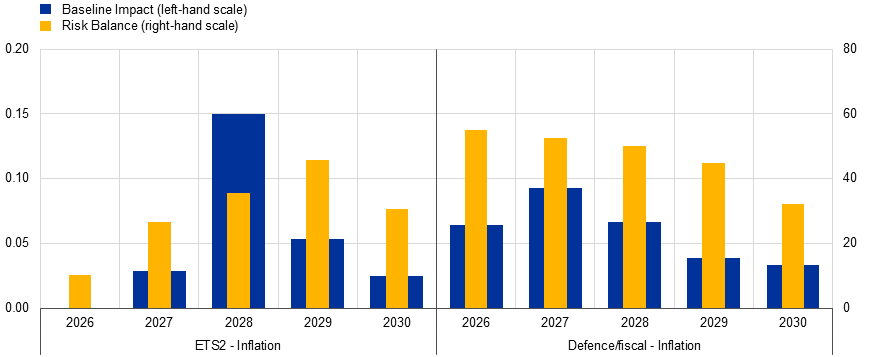
In this round, SPF respondents were asked two special questions relating to (i) the impact of the expanded EU Emissions Trading System (ETS2), and (ii) the impact of defence/fiscal spending measures.[2],[3] In both cases, respondents were asked to state the impact of these factors on their baseline expectations for inflation and real GDP growth, and whether they represented an upside, balanced or downside risk for each of the calendar year horizons (over the period 2026-30).[4] Chart A provides an overview of the expected impacts in terms of both baseline expectations and risk balances.
Regarding ETS2, the strongest impact on baseline inflation expectations was expected to come in 2028 at 0.15 percentage points, in line with the 0.2 percentage point impact embedded in the December 2025 Eurosystem staff projections. The average expected calendar year impact over the years from 2027 to 2030 was 0.06 percentage points per calendar year. Of the 30 respondents reporting an expected impact on inflation in 2028, six indicated an impact of less than 0.1 percentage points, ten an impact of around 0.1 percentage points and 14 an impact of 0.2-0.3 percentage points. Respondents also reported a positive net risk balance, most notably for 2029. Compared with the expected impact on inflation, the expected impact of ETS2 on real GDP growth (and risk assessment) was negative and much lower in absolute size for the baseline impact but broadly similar for the risk assessment.
Chart A
Estimated impact of (i) ETS2 and (ii) defence/fiscal spending on inflation and real GDP growth – baseline expectations and risk assessment
a) Impact of ETS2 and defence/fiscal spending on inflation
(left-hand scale: percentage points; right-hand scale: percentages)
b) Impact of ETS2 and defence/fiscal spending on real GDP growth
(left-hand scale: percentage points; right-hand scale: percentages)
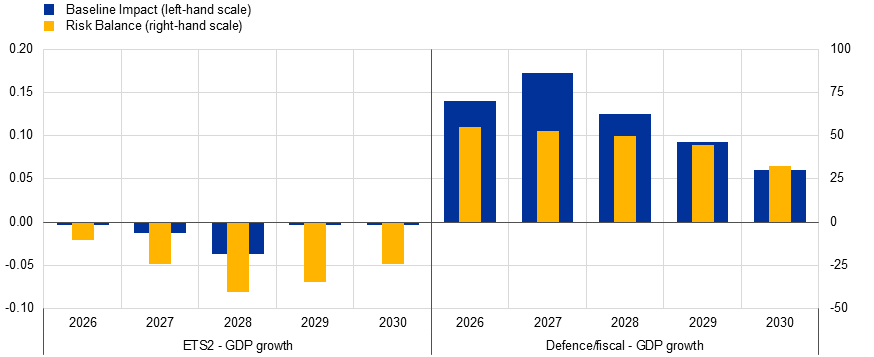
Note: Risk balance is calculated as net percentage of respondents indicating upward and downward risks.
Regarding defence/fiscal spending, the expected impact is stronger on real GDP growth than on inflation (Chart A, panel b, blue line). The average expected calendar year impact on real GDP growth over the calendar years 2026-30 was 0.12 percentage points and 0.06 percentage points for inflation. In terms of risk assessment, the net balance was similar (positive) for real GDP growth and inflation. Compared with the impacts reported in the survey for the second quarter of 2025, the baseline impacts on real GDP growth and inflation are broadly similar, while the risk balance is lower in this round.
SPF respondents’ headline inflation expectations for 2026 and 2027 were unchanged. HICP inflation was expected to decline from the 2.1% recorded in 2025 to 1.8% in 2026 before increasing to 2.0% in 2027 and further to 2.1% in 2028. These expectations were unrevised for 2026 and 2027. Expectations for 2028 were not surveyed in the previous round (conducted in the fourth quarter of 2025) (Chart 1). Respondents reported that the ongoing moderation in wage growth, declines in energy prices, previous strengthening of the euro and competitive pressure coming from a redirection of Chinese trade to Europe were factors exerting downward pressure on inflation. Factors mentioned as exerting upward pressure were tightness in labour markets plus the impacts of increased defence and fiscal spending and climate-related measures. In terms of the more volatile components (food and energy), food price inflation was expected to be slightly weaker in 2026 than in 2025 and to recover modestly in 2027. Compared with the December 2025 Eurosystem staff macroeconomic projections, inflation expectations in this SPF round were 0.1 percentage points lower for 2026, but higher by 0.2 and 0.1 percentage points respectively for 2027 and 2028 (Table 1).
Chart 1
Inflation expectations: overall HICP inflation and HICPX inflation
(annual percentage changes)
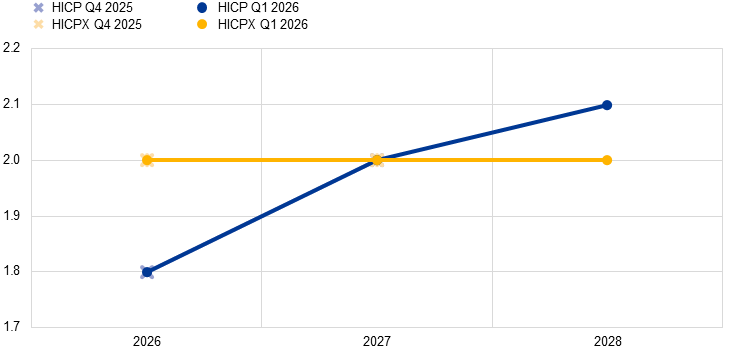
SPF expectations for inflation excluding energy and food (HICPX) were also unchanged for 2026 and 2027. They stood at 2.0% for 2026, 2027 and 2028, 0.4 percentage points below the 2.4% average for 2025. In their qualitative comments, respondents indicated that they expected the ongoing differences between non-energy industrial goods and service inflation to persist. The past strengthening of the euro was expected to contribute to ongoing moderate non-energy industrial goods inflation. While services inflation was expected to remain higher, respondents reported that the moderation in momentum gave greater cause for confidence that services inflation in 2026 would be lower than in 2025. Lower inflation for travel services and lower inflation for services that are repriced infrequently (such as insurance and health) were two examples mentioned. Compared with the December 2025 Eurosystem staff macroeconomic projections, SPF expectations for HICPX were 0.2 percentage points lower for 2026, 0.1 percentage points higher for 2027 and the same for 2028 (Table 1).
Uncertainty surrounding the medium-term inflation outlook eased slightly this round, while the balance of risks was slightly more tilted to the upside.[5],[6] Having eased substantially since the strong rise in inflation observed around the turn of 2022-23, quantitative indicators of uncertainty surrounding the two-year-ahead inflation outlook eased further this round, although they were still at levels higher than those observed before the invasion of Ukraine. The decrease in aggregate uncertainty stems primarily from lower individual uncertainty as disagreement increased slightly. Geopolitics and trade policies were the main factors mentioned as sources of uncertainty. Aggregate probability distributions for the calendar years 2026, 2027 and 2028 are presented in Chart 2. The balance of risk indicator (showing risks around the baseline expectations) for the two-year-ahead horizon became slightly more positive (to the upside) but was still relatively limited at 0.04 percentage points. It should be noted that the average point expectation was 1.96% and the mean of the aggregate probability distribution was 2.00%. Thus, while there are small upside risks to the baseline point forecast, the risks to price stability (2%) are balanced. According to the qualitative remarks, upside risks to inflation expectations include geopolitical developments and commodity prices, trade policies, higher-than-expected wage growth and a higher-than-expected impact from increased defence and fiscal spending. On the downside, weaker global demand, a stronger-than-expected euro, possible disinflationary pressures from a redirection of Chinese exports towards the euro area and weaker labour market conditions were cited. Beyond the near term, some respondents referred to possibly stronger productivity growth stemming from the increasing adoption of AI technology.
Chart 2
Aggregate probability distributions for expected inflation in 2026, 2027 and 2028
(x-axis: HICP inflation expectations, annual percentage changes; y-axis: probability, percentages)
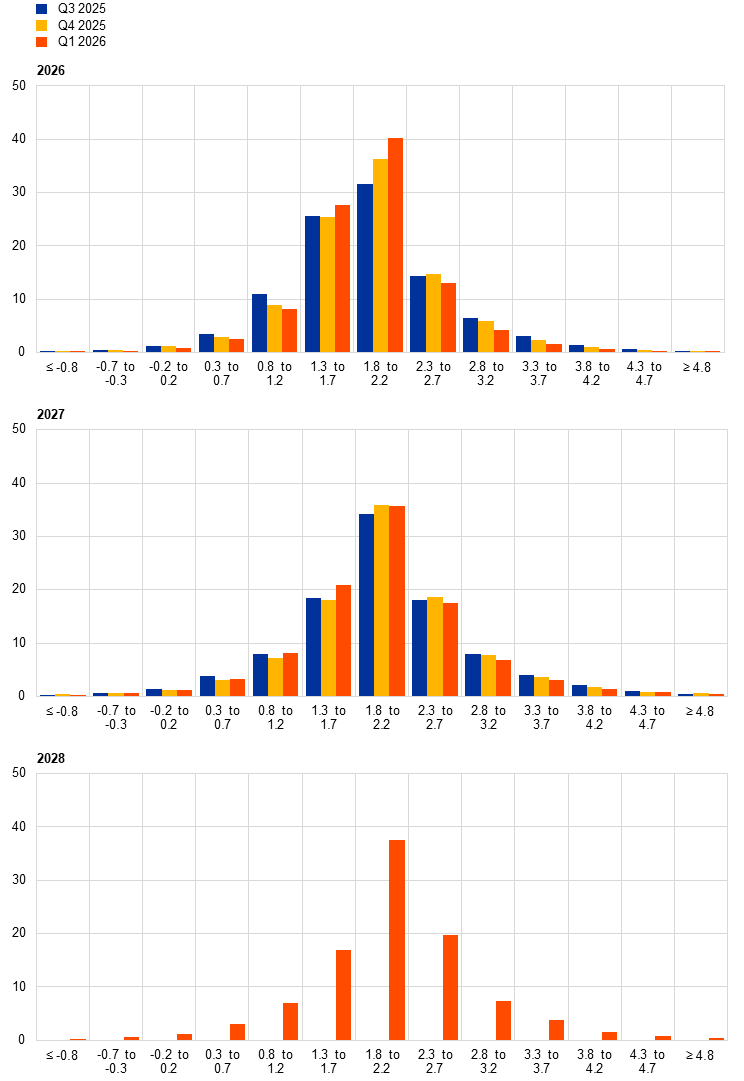
Notes: The SPF asks respondents to report their point forecasts and to separately assign probabilities to different ranges of outcomes. This chart shows the average probabilities assigned to different ranges of inflation outcomes in 2026, 2027 and 2028.
Longer-term inflation expectations were unchanged at 2.0%, and most respondents continued to see headline inflation at 2.0% in 2030 (Chart 3). The modal and median values of the distribution of individual point forecasts were both unchanged at 2.0%, and the shape of the cross-sectional distribution was also largely unchanged (Chart 4).[7] The majority of respondents continued to see inflation at the 2% target in the longer term: for the ninth consecutive round, more than half of the respondents reported longer-term inflation expectations of 2.0% (58% in this round, compared with 63% in the previous round). Compared to the previous round, the histogram of individual point forecasts was largely similar, with around three-quarters of participants reporting expectations between 1.9% and 2.1%, while 13% reported values above this range and 11% below.
Chart 3
Longer-term inflation expectations
(annual percentage changes)
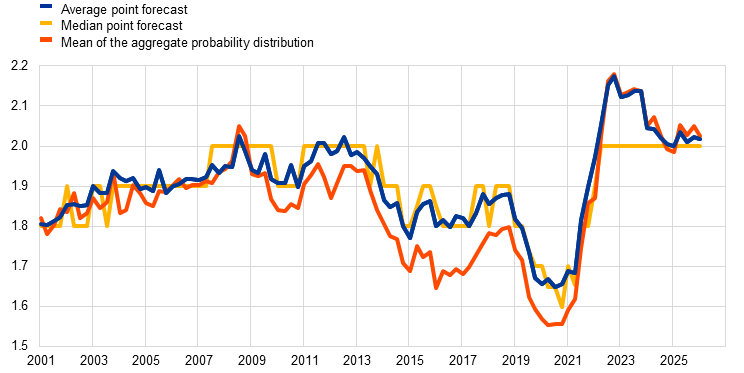
Chart 4
Distribution of point expectations for HICP inflation in the longer term
(x-axis: longer-term HICP inflation expectations, annual percentage changes; y-axis: percentages of respondents)
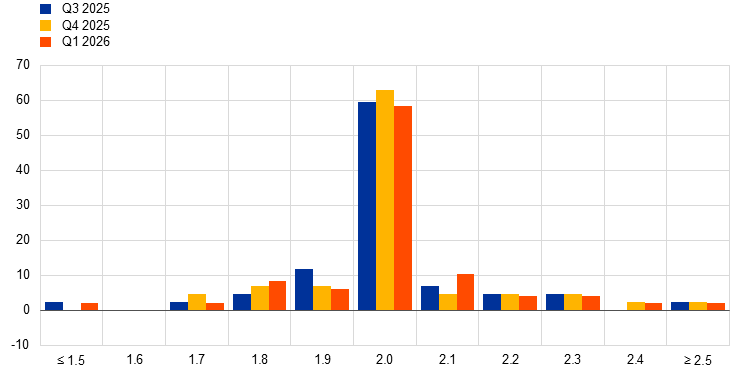
Notes: The SPF asks respondents to report their point forecasts and to separately assign probabilities to different ranges of outcomes. This chart shows the spread of point forecast responses. Longer-term expectations refer to 2030.
Uncertainty surrounding longer-term inflation expectations was largely unchanged, and the balance of risks remained close to being broadly balanced. Aggregate uncertainty (the standard deviation of the aggregate probability distribution) was essentially unchanged in this round (Chart 5), reflecting slightly lower individual uncertainty. This was counterbalanced by slightly higher disagreement regarding point forecasts. The balance of risk indicator decreased slightly and remained close to being broadly balanced.
Chart 5
Aggregate probability distribution for longer-term inflation expectations
(x-axis: HICP inflation expectations, annual percentage changes; y-axis: probability, percentages)
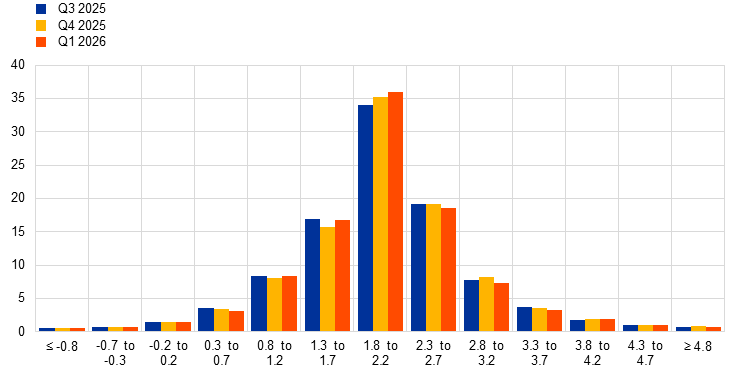
Notes: The SPF asks respondents to report their point forecasts and to separately assign probabilities to different ranges of outcomes. This chart shows the average probabilities assigned to different ranges of inflation outcomes in the longer term. Longer-term expectations refer to 2030.
The mean longer-term expectation for HICPX inflation was unchanged at 2.0%. The median (and modal) longer-term point expectations for HICPX were also unchanged at 2.0%. The gap between longer term expectations of headline and HICPX inflation has been narrowing, and in the past four rounds both measures were virtually identical.
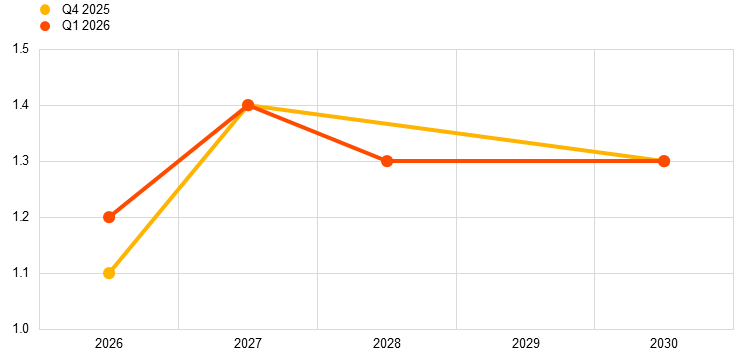
GDP growth expectations stood at 1.2% for 2026, 1.4% for 2027 and 1.3% for 2028 (Chart 6). Compared with the previous round, these figures implied a slight upward revision of 0.1 percentage points for 2026, while the outlook for 2027 remained broadly unchanged. The figures for 2026 and 2027 were in line with the December 2025 Eurosystem staff macroeconomic projections, while the figure for 2028 was 0.1 percentage points lower. The longer-term growth expectations (referring to 2030) were unchanged at 1.3%.
Chart 6
Expectations for real GDP growth
(annual percentage changes)
The upward revisions to euro area growth expectations for 2026 were mainly driven by carry-over effects from better-than-expected GDP data for the third quarter of 2025 and supported by resilience in other macroeconomic indicators. Overall, respondents continued to expect real GDP growth to solidify and strengthen over the period from the fourth quarter of 2025 to the third quarter of 2026 and into 2027. Some respondents said the resilience of the euro area economy was due to the continued strength of the labour market, real wage growth, easing financing conditions and public investment. Regarding fiscal policy, increased public spending on defence and infrastructure was expected to lift GDP growth, counterbalancing the downward impact caused by the US tariffs and trade uncertainty. The expected impact of defence/fiscal spending in 2026 was broadly unchanged compared with the previous survey. However, some forecasters remained sceptical about how great the impact of the fiscal stimulus will be and whether it will materialise as quickly as planned. The quarterly profile for the next quarters is broadly unrevised from the previous round (Chart 7). After the realised growth rate of 0.3% quarter-on-quarter in the third quarter of 2025, which was 0.2 percentage points higher than expected in the previous round, respondents expected slightly lower growth of 0.2% in the fourth quarter of 2025 before a gradual increase throughout the rest of 2026. For the period from the fourth quarter of 2025 to the third quarter of 2026, growth expectations were (on average) broadly in line with the latest Eurosystem projections.
Chart 7
Expected profile of quarter-on-quarter GDP growth
(quarter-on-quarter percentage changes)
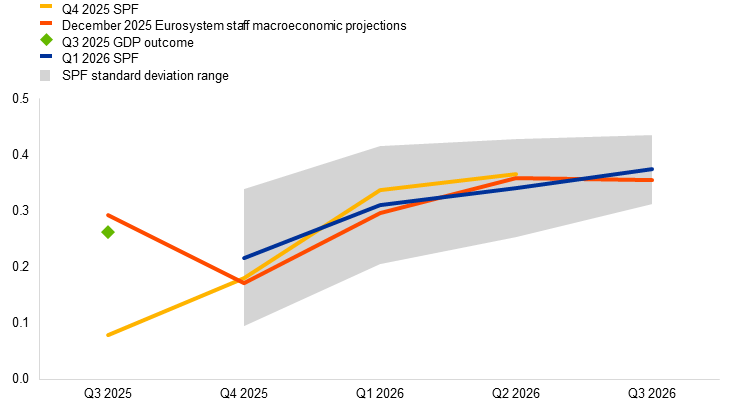
Note: The grey area indicates one standard deviation (of individual expectations) around average SPF expectations.
Uncertainty surrounding the growth outlook remained broadly stable (Charts 8 and 9), while the balance of risks moved closer to a neutral level. While aggregate uncertainty for both the two-year and the longer-term horizons has declined substantially from the level seen in 2020 and is at its lowest level since the pandemic, it remains above pre-pandemic levels. Risks were assessed to be broadly balanced. On the downside, geopolitical tensions and continued trade policy uncertainty were cited as a drag on confidence and investment. While a few respondents saw upside risks from fiscal expansion in Germany, others cited potential delays in its implementation as a downside risk. In addition, some respondents said a potential ceasefire agreement in Ukraine could lead to lower energy prices and boost growth.
Chart 8
Aggregate probability distributions for GDP growth expectations for 2026, 2027 and 2028
(x-axis: real GDP growth expectations, annual percentage changes; y-axis: probability, percentages)
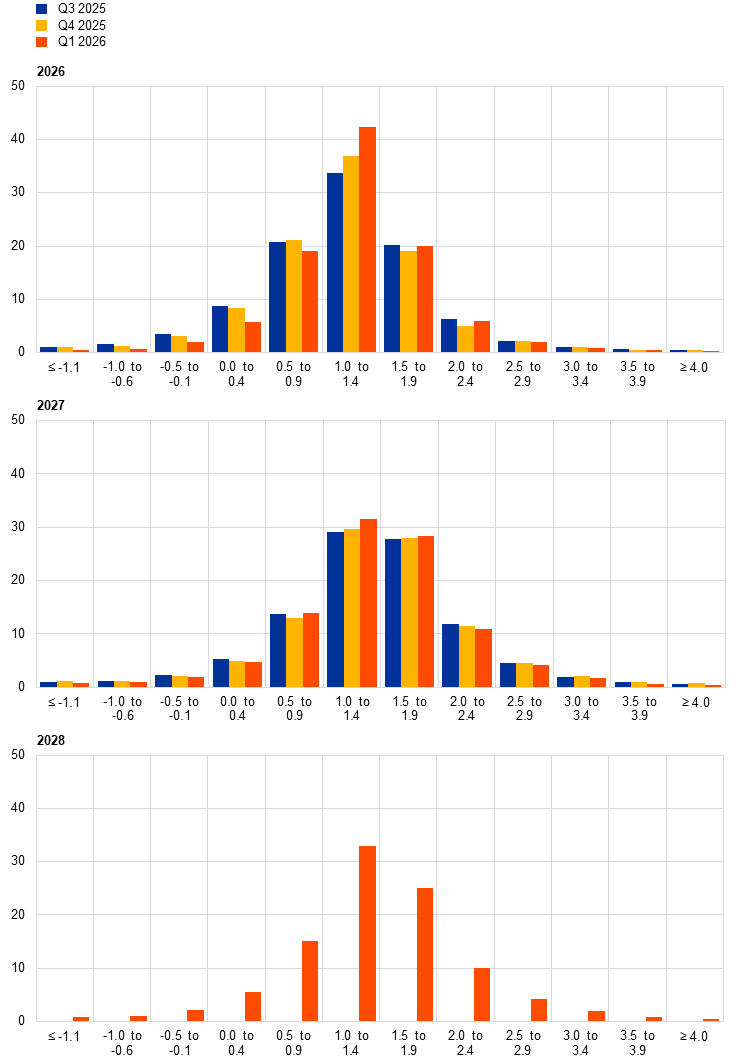
Notes: The SPF asks respondents to report their point forecasts and to separately assign probabilities to different ranges of outcomes. This chart shows the average probabilities assigned to different ranges of real GDP growth outcomes in 2026, 2027 and 2028.
Chart 9
Aggregate probability distributions for longer-term GDP growth expectations
(x-axis: real GDP growth expectations, annual percentage changes; y-axis: probability, percentages)
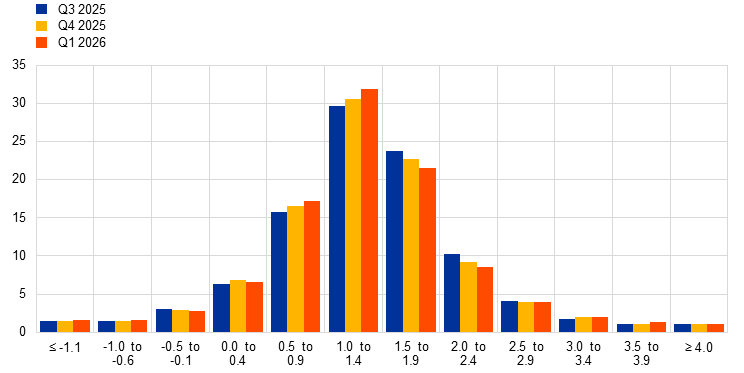
Notes: The SPF asks respondents to report their point forecasts and to separately assign probabilities to different ranges of outcomes. This chart shows the average probabilities assigned to different ranges of real GDP growth outcomes in the longer term. Longer-term expectations refer to 2030.
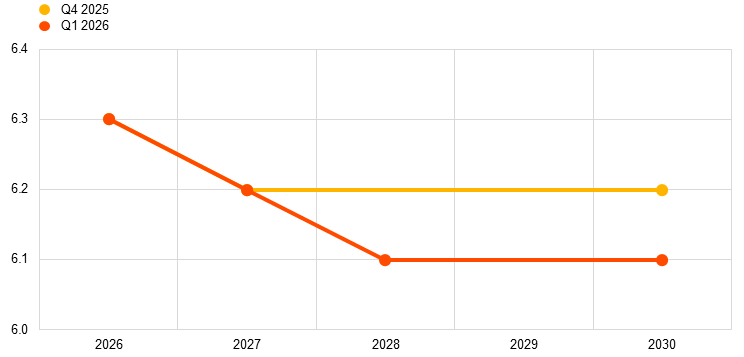
In the survey round for the first quarter of 2026, respondents expected the unemployment rate to be 6.3% for 2026, 6.2% for 2027 and 6.1% for 2028. Compared with the previous survey round, the expected trajectory of the unemployment rate was unchanged for 2026 and 2027 (Chart 10). Respondents continued to expect a largely stable and resilient labour market in the euro area, although some expressed concerns that signs of a slight weakening in labour market conditions have started to emerge. The SPF expectations this round were somewhat above those in the December 2025 Eurosystem staff macroeconomic projections: 0.1 percentage points higher for 2026 and 2027, and 0.2 percentage points higher for 2028. Longer-term expectations for the unemployment rate (for 2030) were 6.1%, 0.1 percentage points lower than in the previous round.
Chart 10
Expectations for the unemployment rate
(percentages of the labour force)
Compared with the previous survey round, the level of uncertainty surrounding unemployment rate expectations decreased further. Aggregate uncertainty, as measured by the standard deviation of the aggregate distributions, decreased slightly for 2026-28 (Chart 11) and for the longer term (Chart 12). Uncertainty surrounding unemployment rate expectations has returned to levels observed before the pandemic and Russia’s invasion of Ukraine. Some forecasters highlighted risks of higher unemployment linked to challenges such as weaker economic growth and AI-driven labour market reallocation pressures. Others mentioned the persistently strong performance of labour markets, particularly in southern Europe, as a downward risk.
Chart 11
Aggregate probability distributions for the unemployment rate in 2026, 2027 and 2028
(x-axis: unemployment rate expectations, percentages of the labour force; y-axis: probability, percentages)
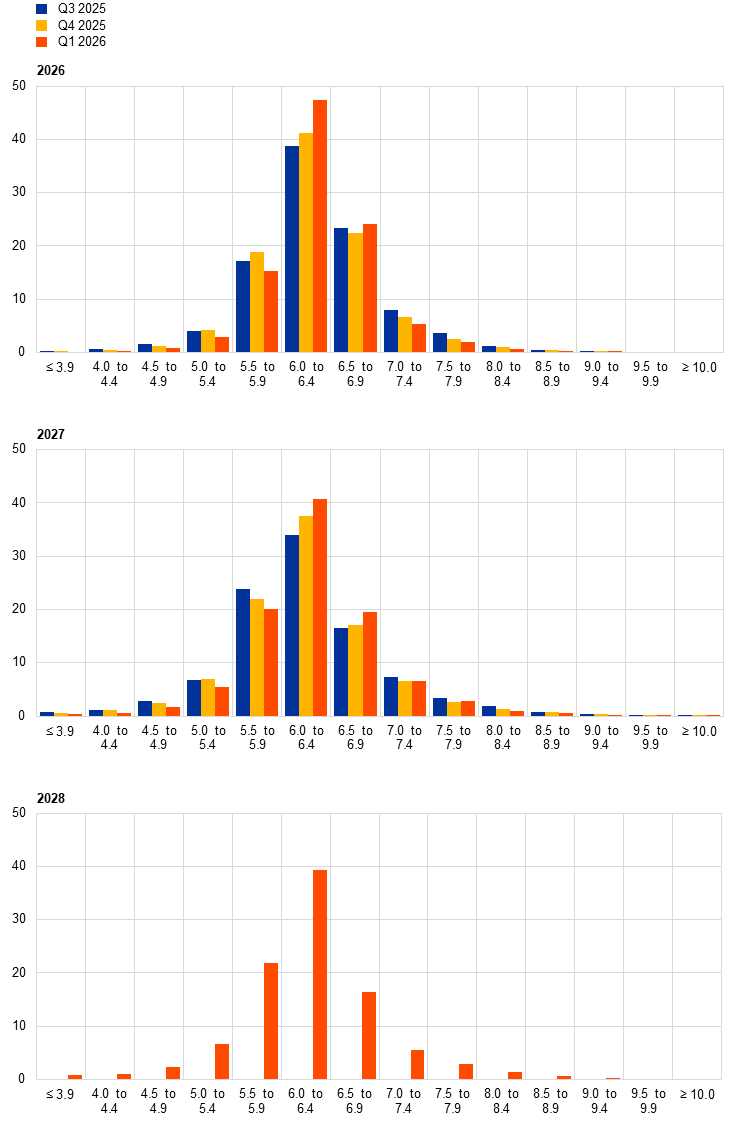
Notes: The SPF asks respondents to report their point forecasts and to separately assign probabilities to different ranges of outcomes. This chart shows the average probabilities assigned to different ranges of unemployment rate outcomes for 2026, 2027 and 2028.
Chart 12
Aggregate probability distribution for the unemployment rate in the longer term
(x-axis: unemployment rate expectations, percentages of the labour force; y-axis: probability, percentages)
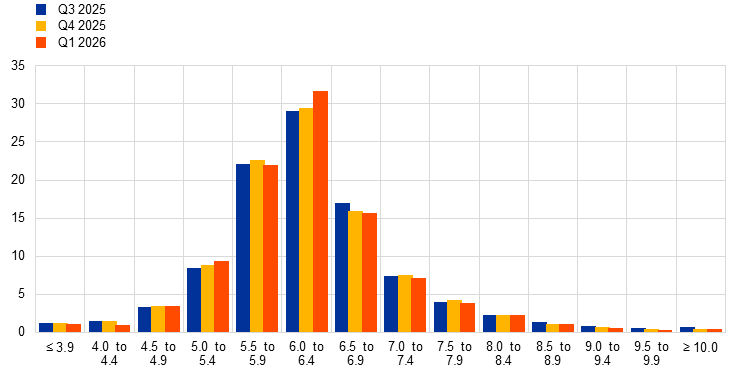
Notes: The SPF asks respondents to report their point forecasts and to separately assign probabilities to different ranges of outcomes. This chart shows the average probabilities assigned to different ranges of unemployment rate outcomes in the longer term. Longer-term expectations refer to 2030.
Modal expectations for the ECB’s deposit facility rate (DFR) remained at 2.0% for all horizons. Compared with the previous round, fewer respondents expected a rate lower than 2% for 2026. Most respondents (80-90%) expected the DFR to stay at 2.0% throughout 2026. From 2027 onwards, while the modal expectation remained at 2.0%, average DFR expectations increased somewhat, as very few respondents expected a rate below 2.0%, and a significant share expected a rate above 2%: around 50% expected a rate of 2.25% or higher for 2028 and 2030 (Chart 13, panel a).[8] Compared with the previous round, shorter-term expectations were adjusted slightly upwards on average. This mainly reflected the fact that fewer respondents expected a rate of 1.75% (10% in this round compared with 20% in the previous round). Expectations for 2027 and beyond stayed at roughly the same level as in the previous round.
Chart 13
Expectations for other variables
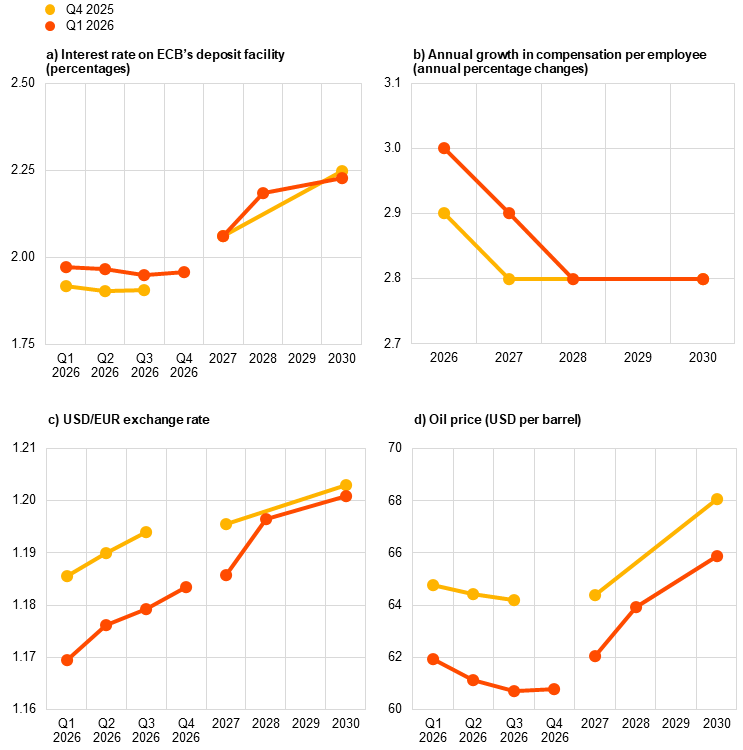
Nominal wage (compensation per employee) growth was expected to moderate to 3.0% in 2026, 2.9% in 2026, and 2.8% in 2027 and the longer term (Chart 13, panel b). Expectations were revised upwards by 0.1 percentage points for 2026 and 2027 but were unchanged for the longer term.
Respondents expected the USD/EUR exchange rate to appreciate very slightly against the dollar from 1.17 in the first quarter of 2026 to 1.18 in the last quarter of the same year, and slightly further to 1.20 by 2030 (Chart 13, panel c). Compared with the previous round, expectations have shifted upwards slightly and still point to future euro appreciation over the survey horizon.
US dollar-denominated oil prices were expected to remain at around USD 64-68 per barrel from the fourth quarter of 2025 through to 2030. Compared with the previous survey round, the expected level of prices was revised downwards over the entire horizon by approximately USD 3 per barrel (Chart 13, panel d).
Excel data for all charts can be downloaded here.
© European Central Bank, 2026
Postal address 60640 Frankfurt am Main, Germany
Telephone +49 69 1344 0
Website www.ecb.europa.eu
All rights reserved. Reproduction for educational and non-commercial purposes is permitted provided that the source is acknowledged.
PDF ISBN 978-92-899-7655-8, ISSN 2363-3670, doi:10.2866/9685179, QB-01-26-048-EN-N
HTML ISBN 978-92-899-7654-1, ISSN 2363-3670, doi:10.2866/1384412, QB-01-26-048-EN-Q
Legal Disclaimer:
EIN Presswire provides this news content "as is" without warranty of any kind. We do not accept any responsibility or liability for the accuracy, content, images, videos, licenses, completeness, legality, or reliability of the information contained in this article. If you have any complaints or copyright issues related to this article, kindly contact the author above.
